I was going to make this last blog about different statistics for the country of Sierra Leone like : population, language, religion etc. But then I got reading a blog from the Alexanders-Tim and Hannah, who are on our advance team. The blog really made me see the country we are going to be entering-not just a break down of numbers. The title is "too comfortable".
"too comfortable.
Each day here I am reminded of how much I have.
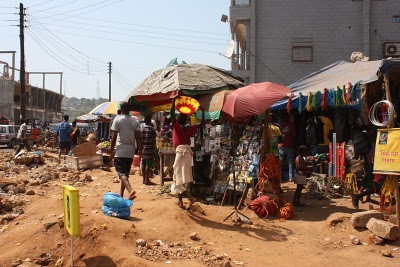
I step out of our concrete-walled house, and exit through our walled compound safely secured by a guard and I see it.
All.around.me.
I see our neighbors sitting outside their one-roomed homes made of metal scraps.
I see it through the tattered, old, simplistic clothing that covers them and their children. Bras are for the rich.
I see it in Margaret’s 3-roomed orphanage with maybe 10 beds for 17 children without a mom or dad.
I see it in their diet. Vegetables are for the wealthy, referred to as “rich food.”
I see it in the lack of water.
I see it in the men (and children) who pound rock into tiny pieces all day for money.
I see it in adverts along the road for HIV treatment
I see it in the children on the streets selling stuff to earn money instead of being in school earning an education.
I see it in eyes of the beggars that surround my car everywhere I go.
I see it in our guards who don’t take a single day off because they can’t afford to.
I saw it in our friend who almost died of malaria.
And just this last week I was beginning to feel sorry for myself. We have been without running water for a week now. I’ve had bucket showers the past few days for the first time. And let me tell you, it’s a little tricky. I can't get over the stench of the toilet from not being able to flush it. At times it can be inconvenient to filter water or boil it. I’ve been longing to go for a run by myself somewhere, anywhere. Or to get back into a regular exercise routine in a gym. I’ve been craving a vegetable salad with broccoli and craisins, and all the various things I love in a salad. Or even fruit (other than pineapple and overripe bananas). Just the other day I was aching for home and all the things I get to do… eat… go… the conveniences.
Then, all I have to do is step out of our house and I am ashamed. I have become too comfortable. I have been so blessed to live such a cozy life (of which I'm SO thankful for). Where unlimited, clean water is for granted. Where we can choose our diet. Like whether we want (or need) organic and vegetarian. Meat is a treat here! Inside I too often want to complain at how hot it is when the majority don’t even have electricity (let alone a/c). I get a little perturbed when the internet is too slow, or even down.
Yet I get to eat three meals a day, sleep on a matress atop a bed, mostly have a proper shower, and drink water whenever I am thirsty. Tonight I have a light bulb to aid my reading or guide my steps to the bathroom, air-conditioning to keep me comfortable, and the internet to stay current with friends on Facebook (or blog) :). They have a small flame. For cooking, for light…for everything.
It’s just that in my excess; my convenient and comfortable lifestyle has brought me discontentment when stripped bare.
I have... Too much. I live... Too easy. I am... Too comfortable."
Thanks Tim and Hannah for sharing from your hearts!-Miss you both!
Monday, January 17, 2011

Saturday, January 15, 2011
"Where We are Headed pt. 3..."
As I talked about in the first blog, one of the factors that is looked at before we enter a country is the level of need.
Sierra Leone is ranked #158 on the Human Development Index. What this means is:


 Please keep our Advance Team in prayer as they prepare the way for the Africa Mercy. Also the crew in prayer as we prepare to minister to the people of Freetown Sierra Leone.
Sierra Leone is ranked #158 on the Human Development Index. What this means is:
- Life expectancy at birth (years) 48.2
- Under-five mortality (per 1,000 live births) 194
- Mean years of schooling (of adults) (years) 2.9
- Expected Years of schooling (of children) (years) 7.2
- Income GNI per capita (constant 2008 US$PPP) 808.7
- Life expectancy at birth (years) 79.6
- Under-five mortality (per 1,000 live births) 8
- Mean years of schooling (of adults) (years) 12.4
- Expected Years of schooling (of children) (years) 15.7
- Income GNI per capita (constant 2008 US$PPP) 47,093.9


Thursday, January 13, 2011
"Where We are Headed pt. 2..."
Before we enter a country, Mercy Ships has an Advance Team, that will go into the country and set up a protocol with the government of the country. There is a lot of preliminary work that our Advance Team has to do before the ship arrives in the country.
One of the aspects of their job is to do some preliminary screenings. To do this fliers have to be published and then passed out.


One of the aspects of their job is to do some preliminary screenings. To do this fliers have to be published and then passed out.


Tuesday, January 11, 2011
"Where We are Headed..."
The next few blogs, I really would like to focus on the country that we are headed-Sierra Leone.


Flag of Sierra Leone
Country of Sierra Leone.
We will be staying at the port in Freetown. One of the ways Mercy Ships decides which country to go to is it's ranking on the Human Development Index (HDI). The HDI is an indicator of health, education, and income of a country. For example according to he 2010 HDI ranking, Norway is #1 on the index, Canada is #8, USA is #4, and South Africa is #110. Sierra Leone in #158 out of #169-which is Zimbabwe.
Sunday, January 9, 2011
"Teaching the Basics..."
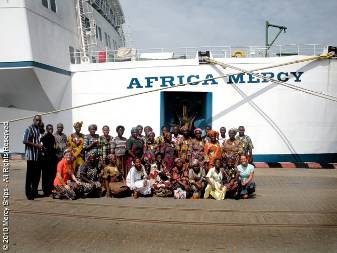
Crew members Becca Taylor and Ellen DePagter were roommates on the Africa Mercy , in West Africa . During the Togo Field Service, Ellen was working and teaching on shore at the Hospitality Center, where patients stay before and after their surgeries – to gain strength before surgery, to recover from surgery, or to undergo post-operative treatment.
One day, Ellen heard that English classes, which were being held at a local church, had been discontinued. The classes had been very popular with the Togolese people.
So, Ellen and Becca decided to help. They organized a one-hour class in which Ellen taught English and the alphabet every Saturday morning to thirty enthusiastic women. Then Becca taught a one-hour class on handwashing, wound care, treatment for diarrhea and other basic health care techniques.
To extend the impact of the program, Ellen trained a Togolese woman, who took over the project when Ellen left the ship. This new leader is very serious about her job. She assigned homework and even had a final exam.
In addition, every other Tuesday, Becca taught specific health care basics to seven women and a pastor. Their homework was to find another place to teach these lessons in the community. “It's been so much fun,” said Becca.
Becca and Ellen made the lessons reproducible, so the project could continue after the Field Service ended. They used a minimum of supplies and no technology. “Just simple, easy-to-find things that they had, resources they could continue to use,” said Becca. “It's working!”
The women are excited about the lessons and want to continue teaching them. One woman is even preparing to expand the program by identifying other topics of interest.
Story by Elaine B. Winn
Edited by Nancy Predaina


One day, Ellen heard that English classes, which were being held at a local church, had been discontinued. The classes had been very popular with the Togolese people.
So, Ellen and Becca decided to help. They organized a one-hour class in which Ellen taught English and the alphabet every Saturday morning to thirty enthusiastic women. Then Becca taught a one-hour class on handwashing, wound care, treatment for diarrhea and other basic health care techniques.
To extend the impact of the program, Ellen trained a Togolese woman, who took over the project when Ellen left the ship. This new leader is very serious about her job. She assigned homework and even had a final exam.
In addition, every other Tuesday, Becca taught specific health care basics to seven women and a pastor. Their homework was to find another place to teach these lessons in the community. “It's been so much fun,” said Becca.
Becca and Ellen made the lessons reproducible, so the project could continue after the Field Service ended. They used a minimum of supplies and no technology. “Just simple, easy-to-find things that they had, resources they could continue to use,” said Becca. “It's working!”
The women are excited about the lessons and want to continue teaching them. One woman is even preparing to expand the program by identifying other topics of interest.
Story by Elaine B. Winn
Edited by Nancy Predaina

Friday, January 7, 2011
"A Christmas to Remember pt. 4..."
Finally, Mike's time to remember! For everyone who knows Mike, he is a bit of a history buff. He loves to look at historic battles, tactics, and strategies. So, for his once in a life time adventure, we went to two of the most famous battlefields in the area-Isandlwana and Rorke's Drift.
Both of these battles happened on 22 January of 1879. The British forces were fighting against Zulu forces. One battle was a complete massacre the other was a remarkable victory.
At Isandlwana-about 20 000 Zulu forces completely overwhelmed the 2 000 British Forces and it became an absolute massacre. After being able to see the terrain that the British had to conquer and how they implemented some of their strategies, it is not too surprising that the Zulu overwhelmed them. For Mike, to be able to stand on the battlefield and have the events of 22 January described to him, it was a very overwhelming experience. It made all his reading and discussions over the years come to life.


Both of these battles happened on 22 January of 1879. The British forces were fighting against Zulu forces. One battle was a complete massacre the other was a remarkable victory.
At Isandlwana-about 20 000 Zulu forces completely overwhelmed the 2 000 British Forces and it became an absolute massacre. After being able to see the terrain that the British had to conquer and how they implemented some of their strategies, it is not too surprising that the Zulu overwhelmed them. For Mike, to be able to stand on the battlefield and have the events of 22 January described to him, it was a very overwhelming experience. It made all his reading and discussions over the years come to life.

The Zulu warrior and the British uniform. Now remember, that it is summer in January in South Africa. The temperatures can get into the High 30'sC/90'sF. It also had been raining at night, so during the day there was high humidity. The ground is rocky and rough terrain. The Zulu fighters knew the area and were prepared whereas the British were not.

The Zulu tactics were to have one group attack from the front and then two other groups attack from the sides thus surrounding the British forces not leaving any British standing.

The area is scattered with piles of white stones. These stones are a memorial to the fallen British forces.

A memorial to the fallen Zulu warriors. It is a Zulu Bravery Necklace.

Mike and I standing at the base of Isandlwana.
On the other side of the hills, at Rorke's Drift, they had no idea what was happening at Isandlwana. They were preparing for their own battle. In the late afternoon of the 22 January 1879, about 4 500 Zulu attacked the hospital and re-supply post at Rorke's Drift. There were about 139 men, of which 36 were patients in the hospital. These 139 men were able to hold off the Zulu forces for 12 hours, when the Zulu finally retreated in the early hours of the morning on 23 January. 11 Victoria Crosses were earned that day at Rorke's Drift.

The hospital at Rorke's Drift.

The church and kraal area (under the trees to the left) where the British held off the Zulu.

Replication of the area of the battle.

Zulu Bravery Necklace

The kids sitting along a stone wall.

The family next to a Buffalo Bush, which is a small, spiky, shiny-leaved bush of great cultural and medicinal significance to the Zulus who, among other names, call it umphafa or isiLahla meaning 'that which buries'. For the Zulu's the tradition is quite clear: should a person die in a place that is not their imuzi or homestead, they believe that their spirit will be unsettled until someone from the village arrives with a branch of isiLahla. The messenger should go to the exact spot where their compatriot died and ask the person's spirit to enter the branch (the tree's straight thorns direct the spirit onto the branch; the curved hooks ensure it doesn't fall off) whereupon it's taken back to the homestead to allow the spirit to finally rest and join the revered ranks of the ancestors.
Overall it was an incredibly memorable Christmas, with expereinces we will never forget. May this New Year be full of love, joy, and peace-with each step of your life being lead by God.
Tuesday, January 4, 2011
"A Christmas to Remember pt.3..."
Christmas Day...
As you can guess by now, our whole Christmas has been memorable. Christmas day was no exception. We started in the morning with an early breakfast. Then we returned to our rondoval to open presents. This year, the picture of the kids by the tree was a bit different than the past.

 After opening presents, we had a quiet afternoon sitting by the "tree" and listening to music by the "fire" and enjoying being together as a family.


As you can guess by now, our whole Christmas has been memorable. Christmas day was no exception. We started in the morning with an early breakfast. Then we returned to our rondoval to open presents. This year, the picture of the kids by the tree was a bit different than the past.

The whole family also received a "Springbok" rugby shirts for Christmas.


Later in the evening, we went to a local hotel where we had reservations for Christmas dinner. The view from this place was amazing!! (Just out of curiosity, we asked what it was for a family of 4 to stay for the night...$525/night...-including breakfast and dinner....but it was still a whole lot out of our budget!) Dinner was no where near the cost!!

View of the Amphitheatre from the Orion Mont-aux-Source hotel

Christmas Day dinner
Stay tuned for Mike's Adventure of a lifetime...
Subscribe to:
Posts (Atom)