Friday, June 17, 2011

"The Tailor..."

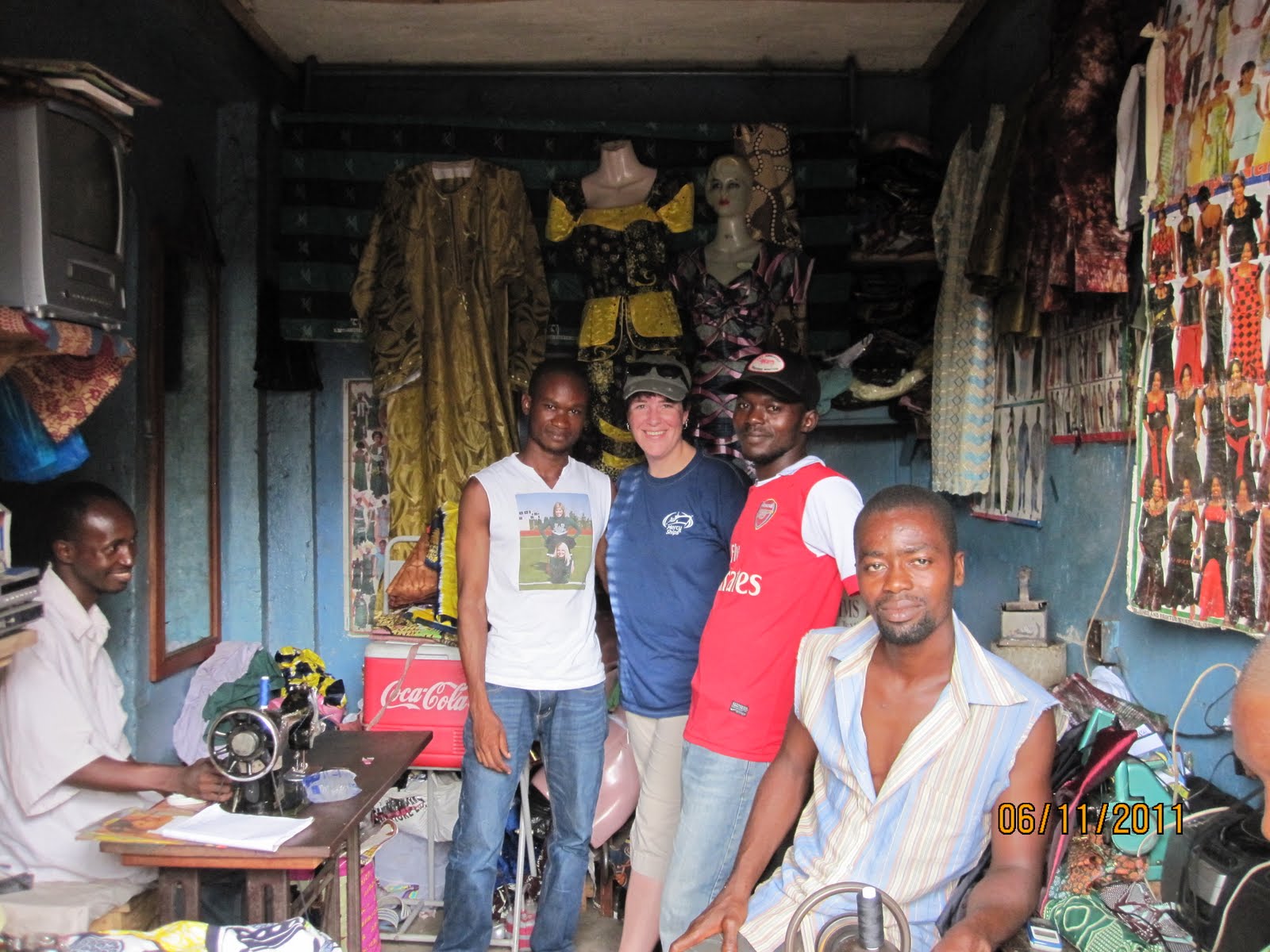
Another profession that amazes me are the tailors.  We have one tailor in particular that comes to the ship every Tuesday.  He does an incredible job.  Many crew members want African print clothing but in a western style.  So they present Foday (the tailor) with a picture, taken from the internet, of the style they would like.  Foday says:  "No problem" and returns in a week with almost the exact replica of the picture.

Most of the clothing that he makes ranges from 20 000 to 50 000 Leones.  (Translation $5-$12 USD)  He has a team of guys that work with him and they all do a spectacular job.
I greatly admire how they look at a piece of fabric, see a design for it, cut it and sew it to measurement.

If you look closely in the picture they have the old treadle sewing machines.  There are three machines in the shop.  It gets very crowded with more that 4 people in the shop.  With such simplicity in the shop, these guys do a magnificent job!

Wednesday, June 15, 2011

"A Miracle for Josephine..."

 Two-year-old Josephine inhaled something that affected her breathing. Her parents, David and Judith, could hear the rattle with every struggling breath. They took her to a local clinic which sent them to an emergency hospital . . . which sent them to a government hospital . . . which sent them to a satellite clinic . . . which sent them back to the government hospital.  After five days in the government hospital, specialist Dr. Karim Kabineh told them that Josephine was so tiny that she would die if he performed the necessary operation. He needed a pediatric anesthetist, anesthesia equipment, and a critical care unit with 24-hour nursing care – all unavailable at that hospital.

After eight days of hopeless searching for help, the desperate parents took Josephine to the office of the Minister of Health, where David hoped to plead his case and find someone who could help. At that moment – in the miracle of God’s timing – Ann Gloag, a member of the Mercy Ships International Board who is well-known for her charity work in Africa, was meeting with the Minister.

As this compassionate woman walked by the family sitting in the reception area, she heard the labored breathing of little Josephine. She put in a call to Dr. Gary Parker, Chief Medical Officer onboard the Africa Mercy, the hospital ship docked a short distance away in Freetown Harbor. After explaining to him what appeared to be the problem, arrangements were made to use an ambulance to transport Josephine, her parents and Dr. Kabineh to the ship.

Dr. Gary examined Josephine, took x-rays and discovered a small stone lodged in the little girl’s bronchus. A virtual think tank was begun to find a way to remove the stone from her tiny body. Dr.Gary approached engineering to see if a medical device could be fashioned that would be the right shape to fit into the bronchoscope and retrieve the stone.  Every plausible idea was examined and eventually rejected.

Dr. Gary and Dr. Kabineh worked for five hours trying to remove the stone without success. Dr. Gary called Ann back to explain that what Josephine needed was a cardiac thoracic surgeon, and there wasn’t one on the ship. David was devastated. Mercy Ships was his last hope. But crew member Clementine Tengue encouraged him, saying, “God will find a way.”

Josephine was admitted to the intensive care unit with 24-hour care. About 3:00 am, ICU Nurse Melissa Warner was working the night shift when Josephine lost her breathing tube.  Her vital signs were crashing.  Dr. Michelle White, the pediatric *anesthetist/ anesthesiologist, was paged, but it would take her several minutes to respond.  “In my mind, I said ‘I need help!’”Melissa said. “And when I looked up, there was Corina Buth standing in the doorway in her pajamas!” Corina, a pediatric ICU nurse from the Netherlands, had been restless and couldn’t sleep.  Corina did CPR, and Josephine’s vital signs returned to normal. Then Dr. Michelle arrived and replaced the breathing tube.
Josephine’s condition was rapidly deteriorating. Analysis was made of the hospitals nearby. Ghana had the required surgeon, but he was absent at that time, and the travel expense to South Africa was prohibitive.

Meanwhile, Ann had phoned a professor friend of hers in Nairobi and explained that she needed a pediatric cardiac thoracic surgeon who could fly to Sierra Leone right away. The professor knew just the right man – Dr. James Munene, head of cardiac surgery at Nairobi’s Kenyatta National Hospital. Although it was quite late, he phoned Dr. James, explained the problem and asked him to go to Sierra Leone to operate on Josephine.

“Wait!” Dr. James said, rather forcefully. “I don’t know what you’re talking about!”
“Just talk to this lady,” the professor responded.
Ann called a few minutes later and told the doctor he needed to fly immediately to Freetown where his skills were urgently needed.
“I was a bit reluctant,” said Dr. Munene. “I had never heard of Mercy Ships. I had no information on this case, and it was the middle of the night!”
Ann called back with information on his flight. “Be at the airport at 6:00 a.m.,” she said.
“It was a little difficult to say no to the lady. I told my wife, ‘I guess I’m going to Sierra Leone in the morning,’” Dr. Munene said.
Then Dr. Gary called to say he was emailing information and x-rays of Josephine.
“I was thinking, ‘It’s not happening! It didn’t sound real!’ But by 1:00 a.m., I had the ticket and all the necessary papers ... and there I was at the airport at 6:00 a.m..,” explained Dr. James.

This confident specialist with the gentle demeanor landed at Lungi Airport, not yet totally comprehending the situation. And he still had to endure the bumpy boat ride across the bay to Freetown. “It was surreal!” he admitted.

Dr. James was overwhelmed by the Africa Mercy, the more than 400 crew members volunteering from 35 different countries, and the concept of bringing hope and healing to the forgotten poor. He couldn’t believe such a mission could have been in operation for so many years, and he didn’t know anything about it.

Teaming with Dr. Gary, Dr. James operated on Josephine, fishing the stone out of her bronchus with ease. Because Josephine was so tiny, it was a vital requirement to have a pediatric anesthetist as part of the team. Dr. Michelle White was serving in this capacity at the time and was a vital part of the team.  “Working with such a tiny body, I wouldn’t have proceeded without her,” said Dr. James.

Josephine awoke shortly after the surgery and sat up on the gurney all the way to the Intensive Care Unit, looking around and asking for a glass of water. To everyone’s surprise, she was anxious to eat right away. After a few days of recuperating in the ICU – and enjoying the attention of the nurses and other crew members – the little girl and her grateful parents left the ship

In reviewing this story, it is amazing to see the many things that had to happen for this tiny girl to survive.  Her parents had to keep her alive for eight days after she inhaled the stone.  Ann Gloag had to be visiting the office of the Minister of Health at the same time that David, Judith, and Josephine were there. Dr. James Munene had to agree to perform a surgery for an organization of which he had never heard; and Nurse Corina had to be drawn to the ICU because she couldn’t sleep.  This incredible timing and all of these wonderful people were part of the miracle that allowed Josephine to grin happily as she left the Africa Mercy as a healthy little girl.

Dr. James was captivated by the mission and hopes to return to volunteer his services. “Really, it’s a privilege to come and see what people are doing while others are sleeping and doing nothing,” he said.

And God never sleeps – miracles still happen every day.  Sometimes we are blessed to be a part of them.


Story by Elaine B. Winn
Edited by Nancy Predaina
Photos by Gerrit Meijerink and Debra Bell

Monday, June 13, 2011

"Fishing Boats..."

One of the hardest, most labour intensive jobs I have seen in West Africa, is fishing.  The men paddle out in the boats drop their nets, and then people on the land will start pulling the net in while the men in the boat paddle back to shore. 

This process of paddling and and pulling of the net in will take "all afternoon", as one fellow told me.  There is not an ounce of fat on these young men. 

Boats will often have a family name, slogan, or verse on them.  They are hand made and extremely heavy.  I was watching a group of 5 men try to turn a boat on its side.  They rocked and rocked and rocked the boat.  It took them about 20 minutes to finally roll the boat.

In the "ruggedness" of the boats, there is a simplistic beauty.


Saturday, June 11, 2011

"Tire Shoes..."

 Tire Shoes for Ortho Patients

“NECESSITY IS THE MOTHER OF INVENTION,” so the old adage goes. Nowhere is it more apparent than in the physiotherapy department onboard the Africa Mercy. When patients’ legs are put in casts, they can’t wear shoes – but they can’t go barefoot, either. The Rehabilitation Team has found a suitable, inexpensive, and easily available way to give each patient the foot protection needed during their recovery. The answer is . . . tire shoes.

Anama Latta, a day-worker in physiotherapy, is responsible for producing shoes from tires in various sizes to accommodate patients. He gathers old tires from motorbikes and begins by removing the wire inside with a knife. Then he measures for sizes – 10” for large, 6” for medium, and 4”| for small. Using a box cutter, he cuts incisions to mark where he will use the scissors to cut through. Next, he cuts three holes on each side.  Then proper lengths of polypropalene ribbon are used to tie the shoes on.
Anama says the tire shoes are stronger than other footgear they might use, and they provide more protection on the sides of the foot.  “When I was a child in Togo, I used to wear shoes like these to go to my Daddy’s farm,” said Anama. “They protect better than flip-flops, and the cast doesn’t get wet.”
Tire shoes last longer than ordinary shoes, and patients can walk easily in them. Anama says he enjoys making the tire shoes. “This is the way I can help them (the patients and the Rehabilitation Team), and I’m happy to make them.”

Story by Elaine B. Winn
Edited by Nancy Predaina
Photos by Liz Cantu

Anama cuts the length of the tires.


Anama cuts three holes into each side of the tire.

Lacing the tires.

Places the tires on the patients feet.

Perfect fit!


Thursday, June 9, 2011

"Last Day..."

Finally.  The last day of school was today.  The kids woke up this morning with much joy in their hearts and on their faces.  Mom and Dad woke with much relief in their hearts.  School is done.  It seems like this year was a long school year. 

There were a lot of transitions this year.  The school year started in Togo, sailed to South Africa, moved off ship to Appelsbosch, moved back on ship five months later, sailed to Sierra Leone, and ended in Sierra Leone.  Also in the midst of all the moving, the teachers were preparing volumes of paperwork for the accreditation of the Academy.

All I have to say is:  "Well done good and faithful servant(s)."

Joshua entering with his class.

Alisia entering with her class.

Miss Nikki addressing the parents and students.

The youngest class, nursery.

Part of the elementary giving their presentation.

Joshua receiving his character trait certificate-willingness.

My now seventh grader....

Alisia receiving her character certificate-loyalty.

My now eleventh grader...

Brain the Academy Administrator addressing the parents and students.

Joshua and his ship best friend, Ethan.

Alisia and her class with mentor teacher Mr. Clavert.

Sunday, June 5, 2011

"Recital..."

Friday night was the night of the Annual Piano Recital.  Aboard the ship, we have some amazing teachers that are willing to give piano lessons to the children.  Friday was the students opportunity to shine.


Alisia introducing her song.

Playing "Beauty and the Beast".

All the children who participated in the recital.

Alisia receiving her certificate of accomplishment.

Thank you so much Nanita and Sharon for your dedication in teaching our children week after week.  Your sacrifice of time is greatly appreciated!

Thursday, June 2, 2011

"Me Pady..."

I,once again have borrowed a blog from another friend.  Allison works in the OR and see things from a bit of a different perspective being an OR nurse.  I share with you her thoughts...

Just the other day I said, “There is nothing new to blog about here, but God surprises me once in awhile.” The past four weeks I have been working in Plastic surgery with a wonderful team of friends- Melanie, Michel, Gillian, and Dr. Tertius. It’s a different kind of plastics we do… not your typical lifts and enhancements. However, children come in with burn contractures due to crawling into a fire or hot water poured on their bodies. A young woman came in with burns on her hands. She tried to save her baby and husband from a house fire, but she was the only survivor. A healing doctor in the village put another patient in a room of boiling water to rid her demons, but instead she had a seizure and fell into the fire. We release the contracture, scar tissue that bends the appendage inward, and then new skin is placed on the wound. What a joy it is to be a part of amazing, life-transforming surgery.
I would like to tell you about my little friend, me pady, Osman. He came in a week ago Monday for a release contracture of his knee. He had sustained an injury to his leg and was taken to a “healer” who placed leaves that were soaked in boiling water on his right leg. Osman suffered burns so intense that his skin healed by pulling his right leg in… his knee was bent permanently at 90% angle. I went and checked in 9 year-old Osman at the pre-op bench on Monday morning and we were both hopeful for his leg to be straight the day he would go home. Due to previous surgery, we had to clean his wounds and bring him back another day. Wednesday, Osman and I met again at the bench and he knew me by now as “me pady in da operation”- my friend in Krio. Finally, Friday came and Osman was ready, he asked me. “Will this be my last surgery?” We bowed our heads and prayed to Papa God that it would be Osman’s last. Dr. Tertius removed skin from his lower leg and placed it behind his knee where it was once bent and we wrapped bandages on his new straight leg.
Today, I was coordinating in the OR and going from room to room helping with counting and cleaning in between cases. I volunteered to go pick up our next hernia patient at the pre-op bench. Standing there, I spotted Dr. Tertius in the hospital corridor walking my way. He told me we needed to bring Osman back for bleeding and I switched quickly into emergency mode. All of us in the OR worked together to get the room ready for Osman- instruments, suture, drugs, blood, and supplies… some that had to be substituted because we are not a fully stocked hospital. I went to ICU to retrieve Osman and could only encourage him, “Me pady, take fine fine care of you, me pady.” Osman went to sleep holding my hand and surrounded with all the prayers of everyone in the hospital. The surgeons and nurses worked into the afternoon, replacing the damaged artery in Osman’s right leg with a vein from his left. We took him to Recovery still unsure if the surgery was successful. When I checked in on Osman in ICU this evening, he was awake, but more importantly concerned about his balloon he lost. I rescued the balloon from Recovery and placed it in me Osman’s hand while he struggled to get comfortable with both legs wrapped in bandages. As I sit here on the computer and on-call, I am asking God again for help. The Lord amazed us, helping us with Josephine’s surgery to remove the pebble from her lung. Tonight, I am asking you to pray for healing and for blood to flow through Osman’s leg. Please, please pray for me pady.