Saturday, August 13, 2011

"I Need Africa..."

I have often stuggled with being able to express what I have experienced in the last two years being aboard the Africa Mercy.  There are many things I will never be able to express - how I have been impacted and how they have changed my view of life.  Some things are just to hard to process being here...maybe in time.

About a month ago this video was played at community meeting.  It begins to describe some of my thoughts that are on the surface...

 ....Food for thought.... click here

This is the text to the video...

I Need Africa More Than Africa Needs Me
When I think of Africa, the following images immediately come to mind: Starvation. AIDS. Child soldiers. Genocide. Sex slaves. Orphans. From there, my thoughts naturally turn to how I can help, how I can make a difference. "I am needed here," I think. "They have so little, and I have so much." It's true, there are great tragedies playing out in Africa everyday. There is often a level of suffering here that is unimaginable until you have seen it, and even then it is difficult to believe. But what is even harder is reconciling the challenges that many Africans face with the joy I see in those same people. It's a joy that comes from somewhere I cannot fathom, not within the framework that has been my life to this day.
The images spilling out of my television showed circumstances that could seemingly only equal misery, and I was fooled. I bought into the lie that circumstance defines happiness. The truth is, in Africa I find hearts full of victory, indomitable spirits. In places where despair should thrive, instead I find adults dancing and singing, and children playing soccer with a ball crafted of tied up trash. Instead of payback, I find grace. Here, weekend getaways are not options to provide relief from the pains of daily life. Relationships and faith provide joy. Love is sovereign.
My new reality… I know now that my joy should have no regard for my circumstances. I'm ashamed by my lack of faith, but at the very same moment I am excited by my new pursuit. I'm forced to redefine the meaning of having much or having little. I'm uneasy with the prospect of change and of letting go, but just the thought of freedom is liberating. I want what I have learned to trickle down from my head into my heart - I no longer want to need the "next thing" to have joy.
I'm not saying that Africa does not need our efforts. It absolutely does need our partnership. But for me, I've come to understand that I NEED AFRICA MORE THAN AFRICA NEEDS ME. Why? Because it is Africa that has taught me that possessions in my hands will never be as valuable as peace in my heart. I've learned that I don't need what I have and that I have what I need. These are just a few of this continent's many lessons. I came here to serve and yet I've found that I have so much to learn, and Africa, with all its need, has much to teach me.

Thursday, August 11, 2011

"Back to School..."

Well after two long months...for Mike and Deb-certainly not for the kids!  Alisia and Joshua head back to school on Tuesday.

Alisia spent her summer working as a receptionist on the ship. She also was working on an online in American Government.

Joshua spent most of the summer playing.  He was involved in the Summer program for most of the summer.  Doing all sorts of activities with the group from going to the beach, exploring Freetown, and playing with the patients on the wards and at the Hope Center.


Going back to school here is very different than in Canada or the United States.
*There is no back to school shopping for clothing or school supplies
*The kids already know who is in their class
*They know their teachers
*They know their classroom
*School is in the same place where you eat and sleep and is only steps away from your cabin
*Your class and teachers can be all different nationalities
*You know everyone in the whole school

The first day of school is always a blessing.  The teachers and families all meet in the International Lounge for a time of prayer and applaude the children and they head off to school for the first day.

Alisia 11th grade.

Joshua 7th grade.

Tuesday, August 9, 2011

"Joshua's Treat..."

Joshua received a real treat the other night.  One of the families returned to the ship from San Francisco.  Ethan, who is Joshua's ship best friend, brought him a Krispy Kreme donut.  For Joshua, this was a taste of heaven.  One of his favorite foods is donuts...

Now this is no ordinary donut.  This donut made it on journey of over 30 hours enduring the ride of buses, planes, taxis, ferries and land rovers to make it to the ship....only to be devoured by Joshua in seconds....


Thank you Ethan for thinking of Joshua and giving him this amazing blessing of a donut!

Sunday, August 7, 2011

"Food For Life Graduation..."

On July 9, 2011, Mercy Ships held the Food for Life graduation ceremony beside the St Clements Junior Catholic School in Waterloo, a suburb of Freetown, Sierra Leone. Sixteen trainees graduated from the Agriculture and Nutrition Project. The event was attended by a representative for the Minister of Agriculture and the Mercy Ships Food for Life in-country partners – City of Rest, Heifer International Sierra Leone, Hope of Glory, and Sierra Canadian Humanitarian and Development Organization.

The Food for Life program focuses on long-term sustainability of organic food production using conservation-oriented methods supported by dietary health benefits. Its train-the-trainer approach will have far-reaching effects across the nation for many years to come. To reap the optimal yield per harvest, the training utilizes natural, practical, low-cost, non-invasive farming methods taken from the Scriptures. It also provides fundamental nutritional advice about creating a healthy balanced diet by using the food grown in each crop. This knowledge will help reduce common illnesses by increasing the volume and variety of vegetables and by improving nutrition.
Corn crop
Each partner in the project recruited farmers to participate in the four-month Food for Life course. The trainees were selected from a wide area of the Western Province so they can support each other as they set up their own training sites.  

Upon arrival, each trainee was allocated a garden plot for implementation of the new techniques. Each day started with a Bible study. Then farming methodology was taught by Mercy Ships Agriculture Program Facilitator, Jean Claude Mouditou. His wife, Anastasie, provided training in nutrition – the nutritional content of specific foods and methods to create a healthy balanced diet – thus supporting long-term health care in Sierra Leone.

Jean-Claude and Anastasie
Bambay Sawaneh joined the program with his wife and baby despite a physical disability he suffered during the war. Rebel soldiers chopped off both his hands. A compassionate nun arranged for him to have a surgery that split the stubs of his arms to allow him to grasp things. Without that surgery, farming would have been impossible. His dedication to farming comes from a family history in agriculture. In comparing the Food for Life methods with the traditional ones, he said, “Through this form of training, I came to learn that we have been wasting our time and wasting our energy. It’s like we’re working like an elephant and eat like ant…We destroyed everything out of ignorance.”
Bambay receieves his graduation certificate
Traditionally, African farmers brush and burn the land before scattering seeds, followed by fertilizing with bought products and watering. The organic methods, which do not use brush and burn techniques, produce a high yield of a greater variety of well-formed vegetables three times a year. The investment of money and labor is reduced, while optimizing natural materials to conserve the environment. For example, farmers produce their own compost, rather than purchasing harsh chemicals. Bambay expressed the hope and enthusiasm the farmers have received from the training, saying, “It’s wonderful! I never knew that we are destroying what God has put on this ground to bless us…Now my eyes are open, we can do it the organic way.”

On the day of the graduation, many guests gathered to celebrate the success of the Food for Life Program in Sierra Leone. As they took their seats, they were entertained by the vibrant choral songs of the Women’s Empowerment for Self Development Association. Mercy Ships Programs Administrator, Keith Brinkman, began the ceremony with prayer and worship. Then Bambay Sawaneh, representing the student farmers, gave a comprehensive summary of the knowledge delivered through the program. Next, Jean Claude addressed the trainees, saying, “In Africa, we are blessed from the West to the East. We are living in the blessing of the Lord. You’ve learned a lot, combining agriculture with nutrition. I’m very proud of you people.”
Gradutes guests
The final speech was delivered by Mercy Ships Off Ship Projects Manager, Tracy Swope. She emphasized the importance of partnering with fellow non-governmental organizations to ensure the new prosperous future.  

This sentiment was echoed by a representative from Heifer International Sierra Leone, who stated, “It is very good training to improve knowledge and skills for organic farming from cultivation to harvest. People will have more fruits to sell, and have money, and have nutrition and benefits from the foods.”

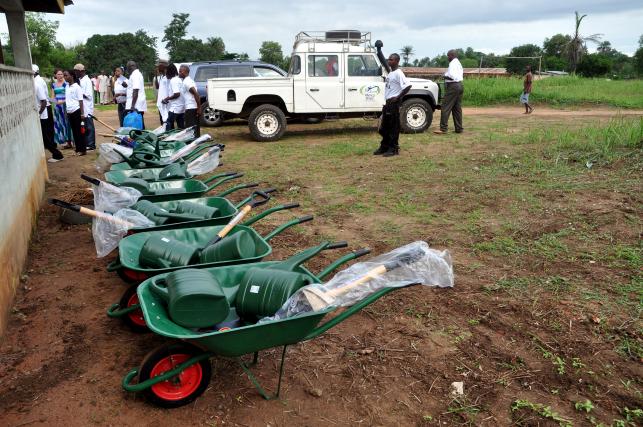
Then jubilant celebration erupted as the student farmers officially graduated. Each one received a certificate presented by the Africa Mercy interim Managing Director, Kerry Peterson. They also were given wheelbarrows, pitchforks and seeds.
Graduation gift
After the ceremony, the newly-graduated farmers led the guests on tours of the cultivated garden plots at the Mercy Ships agricultural site. The plots were densely flourishing with an impressive array of shiny vegetables arranged in tidy rows. Hannah Nasu, one of the farmers recruited by Hope of Glory, confided that she expresses her new-found passion for farming in her spontaneous dancing as she sings gospel songs while watering her garden plot. She explained, “I love the work so much that I built my well to water the plants. This is farming God’s way. Everything God has done is perfect.”

Another farmer, 64-year-old Victor Tamba, impressed guests by energetically leaping around his garden plot. His life was filled with unhealthy living and alcoholism, but the training transformed his life by giving it a new purpose. He is delighted that he can share his new knowledge with other families, bringing joy into their lives. He confidently explained, “God opened my eyes. I have come and learned better things for the future.” In fact, he has already used his newly-learned farming methods to create a vegetable plot at home to start feeding his family home-grown vegetables.

Food ForLife Graduates 2011!
The Mercy Ships Food for Life Graduation Ceremony symbolically marked a new beginning, bright with hope for the future. In a country suffering a shortage of food and high import prices, there must be a radical change in food production. The Food for Life Program has the potential to develop the nation agriculturally as the trainees become trainers in their communities. In Victor Tamba’s words:  “God gave this to me. I never dreamed of it. Now I’m an agriculturist. I know my future will be very good now. I can never, never forget it!”

Story by Claire Ross
Edited by Nancy Predaina
Photos by Liz Cantu

Friday, August 5, 2011

"Seriously?..."

A friend of mine just returned from vacation at home in Tenby, Wales.  She so kindly brought the kids a stick of "Rock". 

Basically a stick of Rock is (much to Joshua's delight) a stick of candly-peppermint flavored.  And the town name of Tenby runs through the length of the candy.

However, I have never seen a warning sign on candy...
Okay...so tell me...what is the adverse effect?  Hyperactivity?  Attention deficit? 

Too funny!!

Wednesday, August 3, 2011

"Baby Barbara pt. 2..."

Since I have been getting caught up on past patient stories, here is the follow up on Baby Barbara.  For the previous article: click here.

Babies born with deformities in West Africa start life as victims of the West African superstition that abnormalities are signs of a curse. When Barbara was born with a cleft lip that extended up into her nasal cavity, her father pronounced that she was a “demon child.”  He ordered his wife to take the tiny infant into the bush and leave her for dead.
Barbara’s brave mother, Aminata, refused to abandon her child.  As a result, she was thrown out of her house and moved in with her sister.  Without a way to support her family, Aminata was forced to separate her four other children and send them to the homes of other relatives.

By the time she was eight months old, Barbara’s weight was drastically low because her cleft lip prevented her from getting the nutrition she so desperately needed.  In fact she weighed less than 4 kilograms (8.4 pounds), less than half of what a thriving baby her age should weigh.  To make matters worse, she had contracted tuberculosis and was placed on a TB program at a local hospital.  Of course, the lack of financial support since the abandonment by the baby’s father was another serious obstacle.

Broken and devastated, Aminata had reached her darkest, lowest point.  Then God stepped in and brought a ray of light. One day Aminata met a woman who said that Barbara was not a “demon child.” She also said that Mercy Ships would arrive in Sierra Leone in just a few weeks.  Volunteer surgeons onboard the Africa Mercy could fix the baby’s lip – for free!  Desperately clinging to this fragment of hope, Aminata took Barbara to a Mercy Ships medical screening.

Aminata was delighted when Barbara was accepted for cleft surgery onboard the Africa Mercy.  However, because the baby was below the acceptable weight for surgery, she was placed on the Infant Feeding Program.  This program provided proper nutrition for the infant and instructed Aminata in a better feeding method. Barbara’s weight gain was monitored each week.

The baby girl gained weight the first week she was on the program, but lost weight during the second week. She developed a fever, and she struggled to breathe or keep her formula down.  The nurses gave her nasal drops to open her nasal passages, allowing her to breathe more easily. The third week she regained some, but not all, of the lost weight.
It was beginning to look like Barbara was not going to be able to have her surgery.  The doctors suspected she might have a cardiac problem, too, which would interfere with plans for cleft surgery.  Those working with the program began praying regularly for Barbara, and slowly she began to gain the required weight.  At the end of three months, despite all her problems, Barbara was cleared for surgery.

The volunteer surgeons repaired the baby’s cleft lip and palate, as well as the centerline of her nose.  Because of her delicate condition, they returned her to intensive care where nurses guarded her recovery.  Clinical Dietitian Jessica King, who supervised Barbara’s case for the Infant Feeding Program, said, “Barbara is a miracle baby.  She had a rough time in the ICU, but she made it. She’ll bring her mom a lot of joy.”

Aminata’s love and sacrificial care for Barbara has been rewarded.  Her tiny daughter may be fragile, but she has a strong will to survive.  She will bless her family with a future of beautiful smiles.

“I’m feeling fine now,” said Aminata, as a tear of joy ran down her cheek.  “I’m thanking God for what He has done for me.”
Story by Elaine B. Winn
Edited by Nancy Predaina
Photos by Tom Bradley, David Peterson and Liz Cantu  


Baby Barbara when she first came to the ship.

Baby Barbara three months later after surgery.

Monday, August 1, 2011

"Namina pt. 2..."

Awhile ago, I posted a blog(previous blog) on a young girl by the name of Namina.  Here is the conclusion to her story.

Five-year-old Namina Yillah suffered from the life-threatening condition commonly known as noma. This malicious and aggressive bacteria destroys the flesh, and it targets children. The statistics are alarming for infant mortality.

Namina was born a healthy baby in Bilo, a village in Sierra Leone, West Africa. When Namina was only18 months old, her mother Wara first noticed symptoms of the savage disease. “At one time in the early morning, her face swelled covering her eyes,” she recalls. With a feeling of dread, she wrapped her baby in a blanket and rushed to the hospital.
The hospital offered daily injections for a week. Dutifully, Wara wrapped Namina onto her back to walk to the hospital each day, yet Namina’s facial tissue continued to rapidly deteriorate. The gaping hole in her face began to expose her bones and emitted a pungent odor. The disease was taking a firm grip on Namina’s life.

Wara and her husband were confronted with a desolate existence.  They lived day to day on a meager income with every breath dedicated to providing for their seven children and caring for Namina.

Wara’s tenuous world imploded when her husband died from an illness. Grief extended its claws to grip the family. There was no money and no one to help . . . and Namina was on the brink of death.

Wara woke early each morning to go to the bush to collect firewood to sell. The few pennies she earned were insufficient to feed her family well, but provided enough scraps of food to barely survive. To exacerbate the difficulties, Namina was beaten by other children. Her deformed face made her a target for bullies. Wara lived in a bleak, dark world that was devoid of hope.

During these difficult days, Wara’s younger brother, Alie, came to her rescue. He drove Wara and Namina to Lungi hospital. The doctors were unable to diagnose the child’s condition, so they transferred her to Aberdeen clinic in Freetown. At last, the first glimmer of hope emerged when Mercy Ships funded the transportation and medical care.
Wara nods for emphasis when she recalls, “Doctor Sandra always encouraged me to wait for Mercy Ships. Without Sandra, if she never come into my life, I give up on life.”
Several years passed. The intensive treatment provided by Dr. Lako had saved Namina’s life, but the little girl still needed surgery to reconstruct her face.

Finally, the Africa Mercy docked in Freetown. Upon seeing the ship, Wara was beset with fears of the unknown. This vast floating metal bowl was likely to devour any living being. So, Wara did what she always does in times of stress. “I always looked to the Almighty to help me,” she explains.

In the ward onboard the hospital ship, Mercy Ships nurses greeted Wara and Namina with warmth and gentle kindness. Overwhelmed by the strangeness of their surroundings, the mother and daughter remained silent.

Accustomed to ridicule and mistreatment, Namina instinctively withdrew to protect herself from the harsh realities of her life. It would take time to understand and trust this new environment. In the meantime, her eyes were determinedly fixed on the ground, and she remained unresponsive even in her native language. On the rare occasions when she glanced up, her burning stare was accompanied by an angry pout. It was evident that she was guarding against any threats to her life.

Finally, it was time for Namina’s surgery. The complex medical procedure involved cutting a flap on her scalp in order to gather tissue to pull through to her cheek to fill the hole in her face. Wara watched anxiously as Namina was wheeled into the Operating Room. She sadly recalls, “During Namina’s surgery I felt so discouraged. I felt Namina will never make it. I wondered if I had a reason to live.” But the compassion and love of the crew members broke through her wall of silence. “Nurse Dan played a great role to make me feel fine,” she shares with a smile.

Through the compassionate and skillful hands of maxillofacial surgeon, Dr. Gary Parker, Namina received a life-changing surgery. And Wara’s hopes and dreams are emerging once again.
Story by Claire Ross
Edited by Nancy Predaina
Photos by Debra Bell